


How to move up the emotional scale is one of those questions that sounds simple until you’re actually in the middle of a bad day trying to do it.
You know the concept. You’ve heard about the feelings scale. You know that moving from frustration to hope is theoretically possible. But when you’re deep in a spiral of self-doubt after a slow month, or lying awake replaying a launch that didn’t go the way you planned, knowing the concept and actually doing it in real time are two very different things.
That’s exactly what this article is for.
I’m going to walk you through the exact method, step by step, using my eight-level emotional scale. By the time you finish reading, you’ll have a practical tool you can use in any moment, on any day, no matter where you’re starting from.
And the best part? You can move the full scale from despair all the way to joy in 10 to 15 minutes. I’ll show you how.
A Quick Look at the Emotional Scale Before We Dive In
If you’re new to the emotional scale, here’s the short version.
The emotional scale is a brain training tool that maps emotions from the lowest feeling states all the way up to the highest. I created my own eight-level version after finding that most existing scales were too complex to actually use in a real emotional moment.
My eight levels, in order from left to right, are:
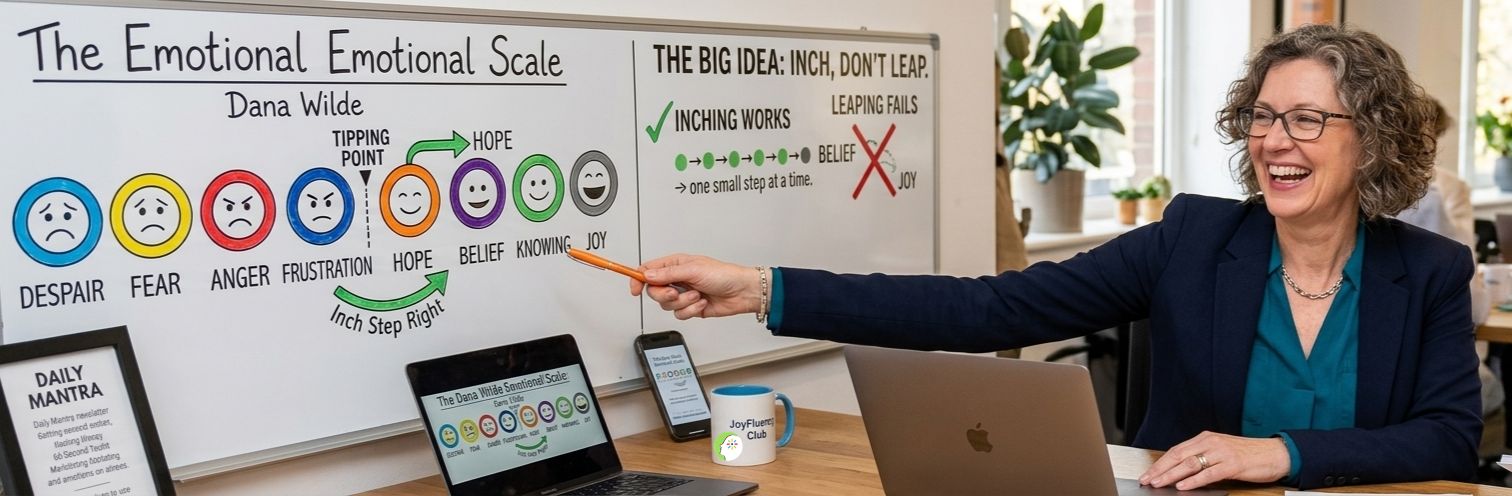
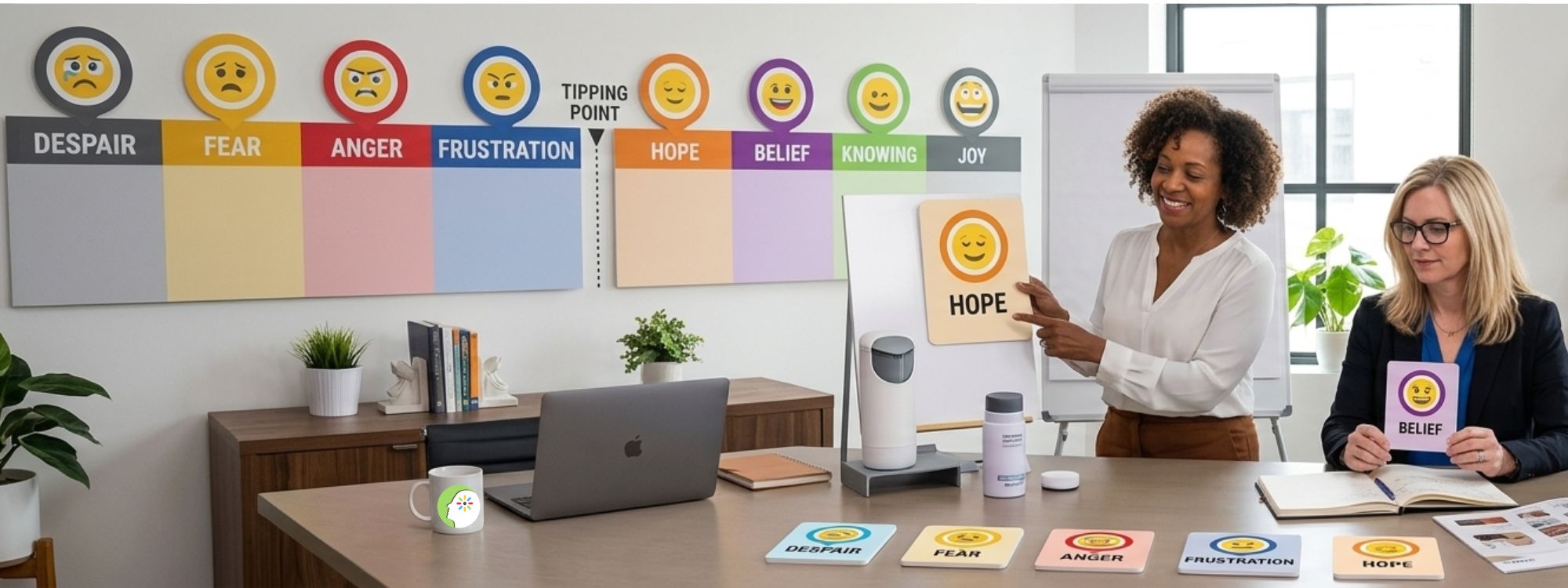
Despair → Fear → Anger → Frustration → Hope → Belief → Knowing → Joy
The scale tips from negative to positive right between Frustration and Hope. The left four are the negative emotions. The right four are positive. And Hope is the gateway, the most important stop on the whole journey.
If you want the full breakdown of every level and what each one feels like from the inside, the emotional scale page has everything you need, including a free downloadable JPEG you can keep on your desk or phone.
So now, let’s get into how to actually move up it.
The Simple Reason Feel-Good Sentences Sometimes Fall… Flat
Before we get into the method, I want to address something that might have happened to you before.
You try to think positive. You pull out an affirmation. And you say “I am happy, I am successful, money flows to me easily.” And it feels like a complete lie. So you stop. And then you feel worse, because now you’re frustrated AND you feel like brain training doesn’t work for you.
Here’s what’s actually happening.
Your brain has a built-in filtering system called the Reticular Activating System, your little matchmaker. Its job is to match your outer world to your inner thoughts. And it can only access emotions that are close to where you currently are on the scale.
When you’re sitting in frustration or fear, and you try to leap straight to joy or gratitude, the gap is too wide. Your brain can’t make that jump. The positive statement doesn’t land because it’s too far from anything that feels true right now.
That’s not a failure of willpower or brain training. That’s just how the brain works.
Here’s Why Forced Positivity Makes Things Worse Instead of Better
When you’re in a negative emotional state, and you try to force a positive one that’s too far away, you don’t just fail to feel better. You actually create internal conflict.
Your RAS is scanning for evidence that matches that internal conflict. It’s looking for proof that you’re stuck, that things aren’t working, that you’re behind. And when you try to paste a cheerful affirmation on top of that, your brain registers the mismatch.
The scale of emotions solves this beautifully. Instead of leaping, you inch. You give your brain something adjacent and believable to move toward. Something close enough that it feels genuinely possible, not like a lie. And that small shift in feeling is exactly what your RAS needs to start looking in a different direction.
From despair, fear is accessible. From fear, anger is within reach. From anger, frustration. From frustration, hope. You don’t have to leap. You just have to take one teeny step.
The Step-by-Step Method for Shifting Your Emotional State One Feeling at a Time
Here’s the full method. It’s simpler than you think, and it works every time.
Step One: Awareness
Before anything else, stop and notice where you actually are on the emotional guidance scale right now.
Don’t pretend. Don’t bypass. Don’t tell yourself you should be feeling better than you are. Look at the scale and find the emotion that honestly matches what’s happening in your body right now.
Despair? Fear? Frustration? Wherever you are, that’s your starting point. And recognizing it is already a win. Most people go through entire days without ever stopping to identify what they’re actually feeling… But you just did!
Step Two: Move One Emotion to the Right
Now pick the emotion one step to the right of where you are and start saying sentences that match it.
Say them out loud if you can. To yourself if you can’t. Keep going for one to three minutes, until you genuinely feel that emotion shift in your body. You’ll know when it happens. It’s subtle at first, but it’s real.
Then move to the next level and repeat.
Step Three: Spend Extra Time at Hope
Of all eight levels, Hope is the one worth really lingering in.
It’s the tipping point from negative to positive, and once you’re genuinely feeling hopeful, Belief, Knowing, and Joy tend to follow naturally. You almost can’t stop them from coming.
Stay in Hope. Keep saying hopeful sentences. Let the feeling build. Then let yourself slide naturally into Belief, and from there into Knowing and Joy.
The whole journey takes 10 to 15 minutes. That’s it. Any emotional state, any starting point, completely movable in 10 to 15 minutes.
The Sentence Starters That Move You Up the Scale of Emotions
Here are the sentence starters for each level of the scale. These are the ones I use and teach. Adapt them to your own situation and say them until you feel the shift.
**From Despair, move toward Fear/Worry:**
“I’m worried that…”
“I’m fearful that…”
“I’m anxious about…”
**From Fear, move toward Anger:**
“I’m angry because…”
“I can’t believe…”
“What is wrong with this situation…”
**From Anger, move toward Frustration:**
“I’m frustrated because…”
“I’m overwhelmed by…”
“I’m stressed about…”
**From Frustration, move toward Hope:**
“I hope that…”
“I like the idea of…”
“I hope things start to shift…”
“I hope I feel better and better as I say these words…”
**From Hope, move toward Belief:**
“I believe things are moving in the right direction…”
“I believe I can figure this out…”
“I believe that I’m already on my way …”
**From Belief, move toward Knowing:**
“I love knowing that…”
“I know that this is working…”
“I know I’m on the right path…”
**From Knowing, move toward Joy:**
“I love…”
“I appreciate…”
“I’m so grateful for…”
Remember: spend real time at each level. Say the sentences until you feel something shift in your body, not just in your head. The feeling is the signal that your RAS has received the new directive and is starting to look in a new direction.
And spend the most time at Hope. It’s the gateway. If you spend time there, you won’t be able to hold yourself back from moving to Belief and beyond. Everything above it gets easier once you’re genuinely there.
How to Use The Emotional Scale in Real Moments in Your Business
Knowing the method is one thing, but knowing when to reach for it in the middle of a real business moment is another. Here are four scenarios where the emotional scale is the fastest reset available.
Before a Sales Call When Anxiety Is High
You’re about to jump on a discovery call, and you’re in fear. You’re worried they won’t like what you offer. You’re second-guessing your price. You’re running the “what if they say no” loop.
Don’t push through from there. That energy comes through on the call.
Instead, give yourself five minutes before you dial in. Start with “I’m worried that…” and work your way up. Get to frustration, then to hope. Even getting to “I hope this call goes well. I hope we connect. I like the idea of them finding exactly what they need” changes everything about how you show up.
After a Launch That Underperformed
A launch lands. The numbers aren’t what you hoped. The self-doubt story starts immediately. “Maybe I’m not cut out for this. Maybe I waited too long.”
That’s despair or fear talking. And if you leave it there, your RAS starts building a case that the story is true.
Pull out the scale. Start where you are. Work up to frustration and then to hope. “I hope I figure out what to adjust. I hope the next one lands better. I like the idea of learning from this.” That’s enough to change the direction your brain is headed.
During a Slow Month
The “I’m so busy, but nothing’s converting” feeling. The comparison spiral. The quiet shame that income doesn’t match effort.
This is frustration territory, which is actually closer to hope than it feels. A few minutes of genuine hopeful sentences and your RAS starts noticing different things. Opportunities you’d been filtering out. Conversations worth having. Ideas that were there all along.
In the Middle of a Comparison Spiral
You’ve seen someone else’s launch results. Their follower count. Their testimonials. And now your own business feels small.
That’s usually fear or frustration. And the fix isn’t to stop looking at other people’s success. It’s to move yourself up the scale fast enough that your RAS starts finding evidence of your own momentum instead.
“I hope I find my best method, too. I like the idea of my clients finding me. I like the idea of my own version of this.” Stay there. Let it build.
The Business Results That Follow When You Raise Your Emotional State
Here’s what actually changes in your business when you shift your emotional state before you take action.
From frustration, you write content that sounds strained and effortful. From hope or belief, you write content that sounds like you. People feel the difference even when they can’t name it.
From fear, your sales conversations feel like convincing. From knowing, they feel like sharing. The words are sometimes almost identical. The energy is completely different.
From despair, you make decisions from scarcity. You underprice. You say yes to clients who aren’t a fit. From joy or knowing, you make decisions from clarity. You attract the right people because you’re operating from your best brain.
Same business. Same strategy. Completely different results based on the emotional state you bring to it.
That’s not a metaphor. That’s your RAS at work. And moving up the scale before you take action is one of the most practical things you can do for your business.
Read the following words out loud or to yourself right now, and feel the shift:
I know how to shift my emotional state.
I don’t have to leap.
I just have to inch.
One sentence.
Then another.
Then another.
I like the idea of feeling better right now.
I’m open to feeling more hopeful.
I am ready to feel more hopeful.
I believe things are moving.
I love knowing my brain is on my side.
I love this tool.
I’m using it right …
… NOW! WOOHOO! 🥳🎉
No emotional state is permanent. No starting point is too low. Moving up the scale is always possible, always available, and always just one sentence away.
Start by downloading the free emotional scale JPEG at danawilde.com/emotionalscale/ and putting it somewhere you’ll actually see it. Your desk, your phone, a sticky note near your mirror. Having it visible when emotions are running high makes the whole method easier to access in the moment.
And if you want a daily brain training boost delivered to your inbox every morning before the day begins, the free Daily Mantra newsletter is exactly that. One short, feel-good directive. Your RAS gets a positive instruction before anything else gets a vote.
When you’re ready to do this work inside a real community of like-minded entrepreneurs who are training their brains every single week, the JoyFluency Club is where that happens!
Frequently Asked Questions
How long does it take to move up the emotional guidance scale?
The full journey from despair all the way to joy takes 10 to 15 minutes when you use the sentence starter method. Each level takes one to three minutes of genuine engagement, meaning you stay with the sentences until you actually feel the emotion shift in your body, not just in your head. The more you practice, the faster it gets. Over time, moving from a negative state to a positive one becomes almost second nature.
What if I get stuck at one emotion and can’t seem to move past it?
This usually means one of two things. Either you haven’t fully owned the emotion you’re in yet, so go back and say more sentences from that level until it feels genuinely felt, not just spoken. Or… you’re trying to move too far in one step. If frustration to hope feels like too big a jump right now, that’s okay. Stay in frustration a little longer. Let the feeling process. The scale isn’t a race; it’s a path. And every path moves forward one step at a time.
How often should I practice this to see real results?
Use it any time you notice you’re in a negative emotional state and you want to shift it. For most people that means at least once a day, often more. The more consistently you practice, the more natural the movement becomes. Over time, your brain starts to recognize the method immediately, and the shifts happen faster. Pairing it with a daily mantra practice or one of these exercises to activate your reticular activating system makes the whole system work even faster.