
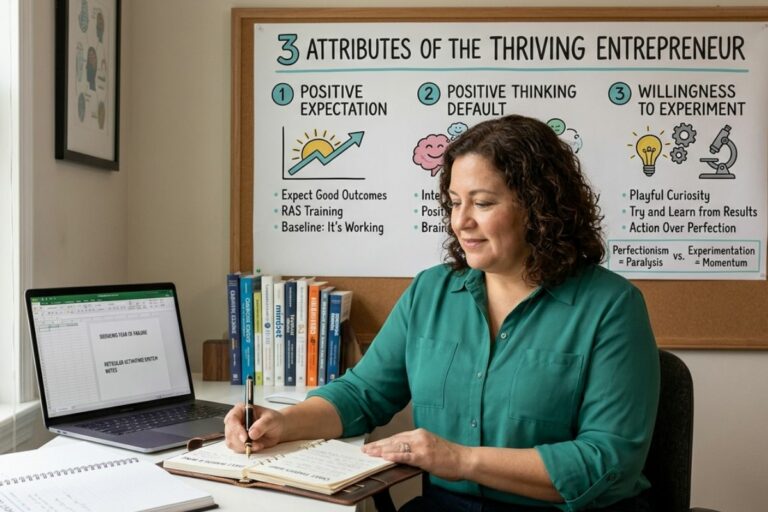

What are three attributes of successful entrepreneurs is one of those questions that sounds really simple, yet it leads somewhere really important.
Most people expect the answer to this thing be something like “hard work” or “resilience” or, say, “strategic thinking.” And while none of those are technically wrong, they miss a much deeper truth….
The 3 attributes that actually separate thriving entrepreneurs from stuck ones are internal. They live in the way a person thinks, not in the tactics they follow or the tools they use.
And here’s the part that I want you to really hear: all three of them are learnable.
You weren’t born with or without them. They’re habits of the mind. And that means, if you don’t have them yet, you can build them. Easy! And you can start today.
Let me walk you through exactly what they are…
What Are Three Attributes of Successful Entrepreneurs?
When researchers look at what separates entrepreneurs who build thriving businesses from those who stay “stuck”, the answer almost never points to strategy, experience, or even talent.
It points inward.
The three attributes that come up again and again are these:
First, a high level of positive expectation. Successful entrepreneurs genuinely expect to succeed! They assume good outcomes are possible, and naturally, their brains go looking for evidence to support that assumption.
Second, a naturally positive way of thinking. Successful entrepreneurs put a positive spin on things by default. They don’t ignore reality, of course, but their brain’s first interpretation of events tends to lean toward possibility, rather than threat.
Third, a willingness to experiment. Successful entrepreneurs take action from a playful, curious attitude. They try things. They learn from results. They adjust and keep going without needing every step to be guaranteed before they go forward.
Did you notice none of these are personality types? None of them are fixed. They are trainable habits of the mind. It’s as simple as that.
By the way, if you want to see how these attributes show up in the broader picture of what makes entrepreneurs succeed, the deep dive on characteristics of successful entrepreneurs is a great companion to this article.
The First Attribute of Successful Entrepreneurs Is a High Level of Positive Expectation
Positive expectation is not wishful thinking. It’s not crossing your fingers and hoping things work out…
It’s a trained internal default that says: “I expect this to work. I expect to figure this out. I expect success to come!“
Successful entrepreneurs carry this expectation with them into every project, every product launch, every sales conversation. But that doesn’t mean they never doubt themselves. It just means their baseline assumption is that things will work out, not that they will fall apart.
Here’s why this matters so much from a brain science perspective.
Your brain has a built-in filtering system called the Reticular Activating System, or RAS. Its job is to match your outer world to your inner thoughts. Whatever you expect consistently, your RAS goes looking for evidence of it.
An entrepreneur who expects to struggle finds evidence of the struggle. An entrepreneur who expects to succeed finds evidence of the momentum, the opportunities, the small wins that signal things are moving.
Same business, same market, same starting point. But… completely different experience and completely different results.
And here’s what I love most about this: positive expectation responds to consistent practice within 72 hours! Yes, you read that right! Just 3 days of intentionally shifting your thoughts toward positive expectation can start changing what your brain notices and attracts.
That’s not magic. It’s just how the brain works.
How to Build a High Level of Positive Expectation as an Entrepreneur
Start with what’s already working (not what is not).
For instance, every morning, before you open your inbox or check your analytics, write down three things in your business that are going right. They don’t have to be big. Anything works: a kind email from a client, a post that got more reach than usual, or a call that felt good.
Your RAS will start finding more of whatever you point it toward. Point it toward evidence of success, and it’ll find more of that.
Pair this with a daily mantra that plants positive expectation directly in your brain. Something like: “I expect good things today.” Or: “I trust that this is working.” Repeat it in the morning, when you livestream, before a client call… whenever doubt creeps in.
This is exactly what the Train Your Brain method is built on. You become a proactive thinker instead of someone running on default. And your business starts to reflect that shift.
FYI, if you want to go deeper on how to work with your RAS directly, read the full post on how to activate your Reticular Activating System.
The Second Attribute Is a Naturally Positive Way of Thinking
Here’s the thing about positive thinking: most people hear that phrase and immediately think it means pretending everything is fine when it is not.
That’s NOT what this is.
The second attribute of successful entrepreneurs is that they naturally put a positive spin on things. On setbacks. On slow months. On feedback that stings. On strategies that didn’t work the way they hoped, etc.
Their first interpretation of events leans toward possibility. Not because they’re unrealistic, but because their brain has been trained to look for what keeps them moving forward!
Let’s say a launch underperforms. The struggling entrepreneur might say: “Ugh! This proves I’m not cut out for this.” But the successful entrepreneur might say: “Well, that didn’t go how I wanted, but what does this tell me about what my audience is actually looking for? Can I feel that need?“
See? Same event. Two completely different internal responses. And those responses will shape every single action that follows.
Now, I want to be clear about something important.
If positive thinking doesn’t come naturally to you right now, that doesn’t mean you’re broken or pessimistic by nature. It means your brain has been running on default, doing what untrained brains do: scanning for threat and flagging problems.
Your brain can cycle through 60,000 to 90,000 thoughts a day. And about 95% of them are the same thoughts you had yesterday. So if yesterday’s default was “this is hard, and I’m behind,” well, that loop runs today too, without you even noticing.
Brain training interrupts that loop. It gives your brain a new default to run on. And with consistent practice, the positive spin becomes a natural response for you.
And this is a trainable skill. Full stop.
The Third Attribute Is a Willingness to Experiment
This one’s my favorite!
Successful entrepreneurs take action from a playful, curious attitude. They simply try things. They genuinely want to know what happens when they do. And they don’t need a guaranteed outcome before they make a move.
They treat their business the way a scientist treats a hypothesis. “Let’s see what happens when I try this.” Not: “This has to work, or I am a failure.”
Think about what that shift does to the experience of running a business.
When you approach every new strategy, every new offer, every new piece of content as an experiment, you remove the weight of needing it to be perfect. You free yourself from the idea that a result that doesn’t go as planned means something is wrong with you.
Every result becomes information. Every attempt becomes a step forward, even if the step teaches you what not to do next time.
In the Train Your Brain approach, this is the energy of Intentional Action. You feel good first, then you take action, and you take that action from a place of genuine curiosity rather than fear of getting it wrong.
The woman who approaches her business this way shows up differently. She posts and makes offers, not because she is steeped in certainty, but because playing is a business strategy.
And because she is not attached to a specific outcome, she is free to actually learn and grow from whatever shows up.
PS: for more on how to build this kind of confidence in action, take a look at how to be more confident as an entrepreneur.
Why Experimentation Beats Perfection Every Time in Business
Perfectionism and experimentation cannot coexist.
Perfectionism says, “I cannot put this out until it is exactly right.” Experimentation says: “Let’s put this out and see what we can learn.”
Perfectionism creates paralysis. But experimentation creates momentum.
And here’s the thing that most people don’t say out loud: those who built a thriving business made a lot of failed attempts along the way. They posted content that flopped, or ran offers that didn’t sell, or even tried strategies that taught them what the audience didn’t want.
None of that stopped anyone… Because as long as you’re just experimenting, it’s OK if you’re not performing.
When you give yourself permission to experiment, you also give yourself permission to keep going. And that’s the single most consistent predictor of success in any business.
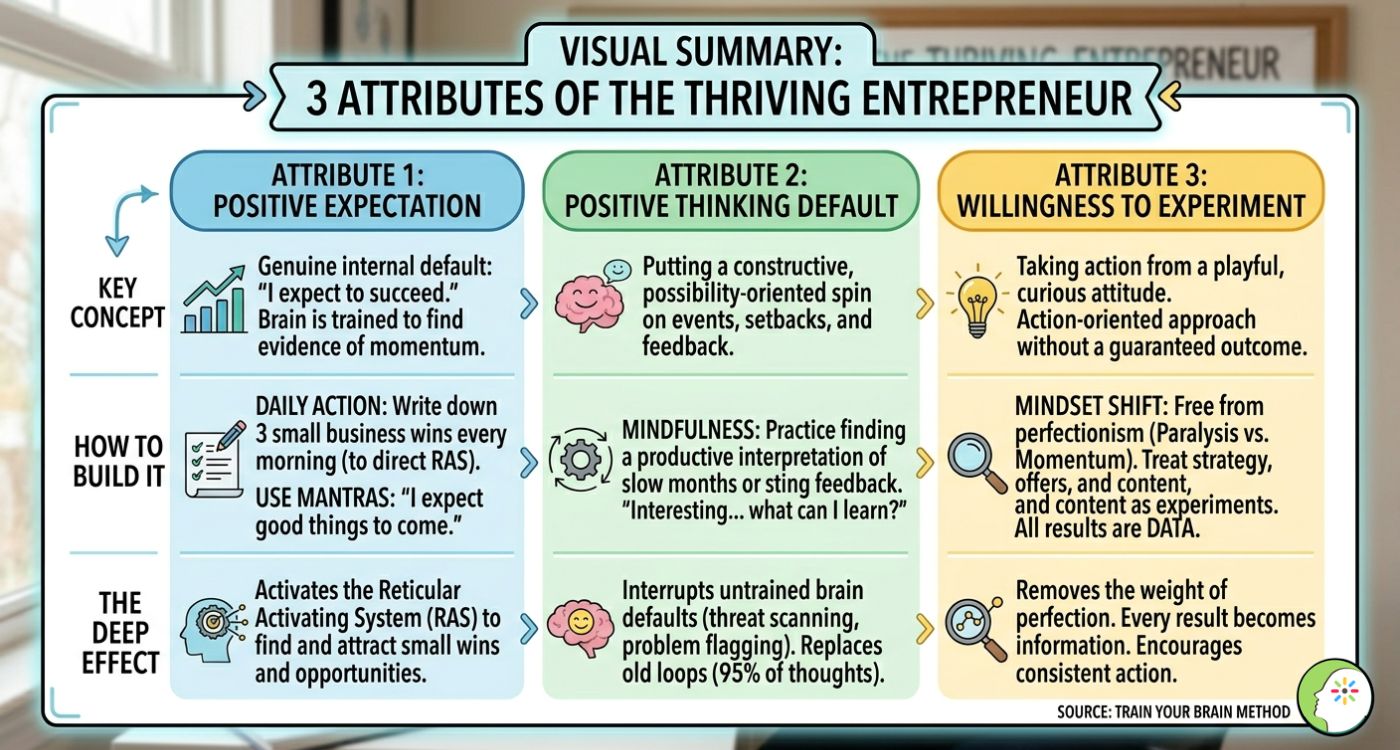
All Three Attributes of Successful Entrepreneurs Are Learnable
I want to say this one more time because I think it’s the most important thing in this entire article.
Positive expectation, positive thinking, and a willingness to experiment are not personality traits you were either born with or without.
They are habits of the mind. And habits can be built.
Maybe you’re reading this thinking: “But Dana, I’m a natural worrier. I’ve always been anxious. Thinking positively doesn’t come easy to me.”
I hear you. And I want you to know: that still doesn’t disqualify you from any of this.
Your current default way of thinking is just that. A default. It formed over years of running on autopilot, cycling through the same thoughts, absorbing the same messages about what’s possible for someone like you.
It’s not permanent. It’s just where you’re starting from.
Train Your Brain is exactly what it says it is. A method for training your brain to think differently on purpose, consistently, until the new way of thinking becomes the new default.
You build positive expectation by directing your RAS toward evidence of what’s working.
You build a positive way of thinking by interrupting the default negative loop and replacing it with a different thought, again and again, until the new loop runs instead.
You build a willingness to experiment by approaching one thing this week as a genuine experiment, with curiosity instead of judgment, and noticing what that feels like.
One step at a time. One day at a time. That’s how the brain changes.
For a fuller picture of how personal growth and business growth connect, the post on tips for personal growth is worth a read.
Now, read the following words out loud or to yourself, and feel the shift:
I like the idea of expecting good things.
I like the idea of expecting my business to grow.
I like the idea of expecting to figure it out.
I am open to thinking positively.
I am open to putting a positive spin on things.
I am willing to experiment.
I am curious about what happens next.
I like playing with different angles and seeing what works.
I like trying new things.
I am a lifelong learner.
I am getting more and more positive.
I am getting better and better at expecting positively.
I can feel the shift already.
I’m already doing it.
I’m doing it right …
… NOW! WOOHOO! 🥳🎉
If you want to start each morning with a short, powerful mindset boost that trains all three of these attributes a little at a time, sign up for the free Daily Mantra newsletter. I send it straight to your inbox every morning, and it’s one of the simplest ways to start building a new brain default, one day at a time.
And if you’re ready to do this work inside a real community of like-minded entrepreneurs, come check out the Joyfluency Club. It is where we train our brains together every single week.
You totally got this!
Frequently Asked Questions
Can I really learn to think like a successful entrepreneur if I’m naturally a worrier?
Yes. Absolutely yes. Worrying is a habit, not a fixed personality trait. Your brain defaults to it because it has practiced it for a long time, not because that’s who you are at your core. Brain training gives your brain a different pattern to practice. With consistency, the new pattern becomes the stronger one. It doesn’t happen overnight, but it does happen surprisingly quickly when you focus your thoughts and train your brain.
What is the fastest way to start building positive expectation?
Start a daily wins list. Every morning or evening, write down three things in your business that went right that day. They can be tiny. The point is to direct your Reticular Activating System toward evidence of what is working. Do this for 72 hours and notice what shifts. Most people feel a difference within three days because that is how quickly the RAS responds to consistent new focus.
How does experimentation help an entrepreneur grow a business?
Experimentation removes the fear of failure from taking action. When you try something as an experiment, a result that doesn’t go as planned is not a verdict on your ability. It’s data. That reframe changes everything about how consistently you’re willing to show up and try new things. And consistent action, taken from a curious and grounded place, is what actually builds a business over time.
Are these three attributes more important than strategy or skills?
Yes. They work together, but the internal attributes come first. You can hand two entrepreneurs the exact same strategy, and the one with positive expectation, a positive default way of thinking, and a willingness to experiment will get better results. Not because the strategy worked differently, but because of how they showed up inside of it. Skills and strategy matter. But the internal state you bring to them matters more.