
THE EMOTIONAL SCALE
The emotional scale is a tool that we use to shift our emotions in any given moment. It’s one of the most practical brain training tools because it solves a problem that most positive thinking advice completely ignores. I’ll explain.
THE ADVICE
Maybe you’ve heard a self-help guru tell you to “think positive.” But here’s the problem with that advice. If you’re in a bad place emotionally when someone tells you to “just think positive”, “say some affirmations”, or “choose happiness”, it just makes you angry, right?
THE GAP
That’s because if you’re feeling worried, overwhelmed, or defeated, it’s just too big of a jump emotionally to feel “positive. The gap between where you are emotionally and where you’re trying to get to is just too wide!
THE TRUTH
That’s not a failure of willpower. That’s a brain science problem. And the emotional scale is the solution.
Instead of asking you to leap from despair to joy in one jump, the emotional scale shows you that you only ever need to move one step to the right. One accessible emotion at a time. One sentence at a time.
When you move across the emotional scale, one emotion at a time, it’s easier. It feels natural, and you can move all the way to joy in 10 to 15 minutes. I show exactly how to do it below.
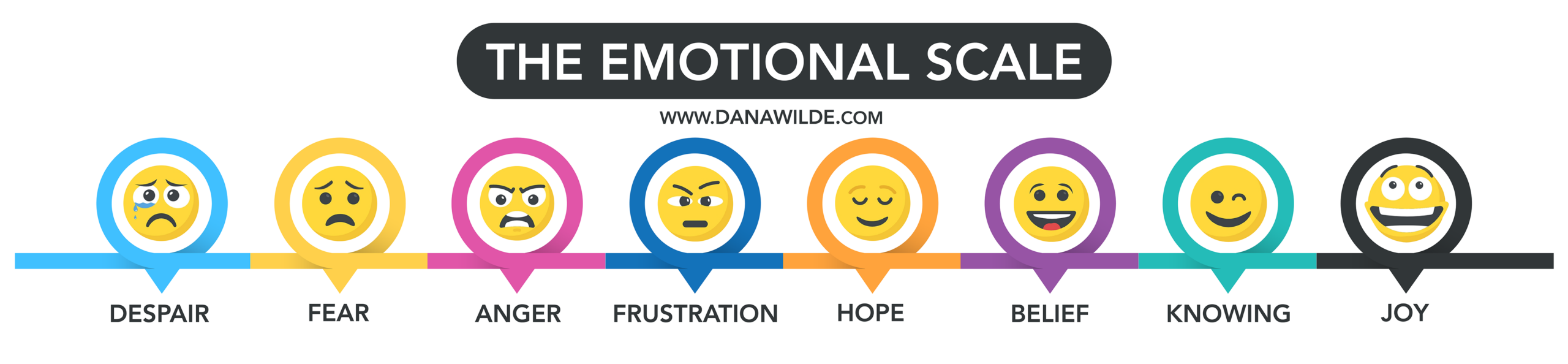
Before you scroll, grab the free emotional scale JPEG right here! Put it on your desk, your phone, or a sticky note near your mirror. Having it visible when emotions are running high makes all the difference:
What Is the Emotional Scale?
The emotional scale is a tool for shifting your emotional state to a more positive place, one step at a time.
This emotional scale was inspired by the work of Abraham Hicks, David Hawkins, and others, but I found some of the other scales to be too complex. There were too many levels to remember, which is especially trying when you’re not feeling great.
So, I created this scale, because I wanted a scale that was simple and easy to use. Eight levels. Simple enough to use at any moment, and yet, practical enough to actually work.
Here are the eight emotions on the Dana Wilde Emotional Scale, in order from left to right:
Despair → Fear → Anger → Frustration → Hope → Belief → Knowing → Joy
The scale tips over from negative to positive right between Frustration and Hope.
The left four emotions (Despair, Fear, Anger, and Frustration) are what we could call the “negative” side of the scale. Although, it’s worth noting that the more you understand brain training, the more you will discover there are no “negative” emotions.
The right four (Hope, Belief, Knowing, and Joy) are the positive side.
Hope is the gateway. Once you get there and really feel it, the rest tends to follow naturally.
THE EIGHT EMOTIONS ON THE SCALE
Here’s what each level actually feels like from the inside, in plain English.
1 - DESPAIR
Also called powerlessness or defeat. This is the "what's the use anyway" place. The curled-up-in-bed, nothing-is-working, I'm-never-going-to-amount-to-anything feeling. It's heavy. It's exhausting. And it's a completely valid place to start from.
2 - FEAR
Also called worry. That low hum of anxiety. The "what if this all falls apart" loop. The "I'm worried I won’t make it" feeling that can sometimes follow you around. It's uncomfortable, but it's actually a step up from despair because worrying feels like you’re “doing something” compared to despair.
3 - ANGER
Also called revenge. Anger actually feels a little better than fear because there is even more energy movement in it. There's a sense of taking your power back, even if it's not directed anywhere useful yet. "I can't believe this. What is wrong with me? What’s wrong with them? Why isn't this working?" That's anger. And it's a real step forward on the scale.
4 - FRUSTRATION
Also called stress or overwhelm. "I'm doing everything right, and it's still not working. I'm stressed. I’m overwhelmed. It's taking too long." Sound familiar? Frustration is incredibly common territory for hard-working entrepreneurs. And it's one step away from Hope.
5 - HOPE
Also called wishful thinking. This is the first positive emotion on the scale and one of the most important stops on the whole journey. Even a small, genuine flicker of hope signals a real shift in your emotional state. "I hope I can figure this out. I hope something happens out of the blue. I hope things get easier." Hope is enough to get you where you want to go.
6 - BELIEF
Starting to feel like it could actually happen. Not just wishing anymore, but genuinely beginning to trust the process. "I do believe I can make this work. I believe I'm on the right path. I believe in what I’m doing." This is where the energy starts to shift in a big way.
7 - KNOWING
I call this positive expectation. It's a settled, quiet confidence. Not loud or forceful, just sure. "I know this is working. I know I'm on the right path. I love knowing I am meant to do this." This is a feeling of sureness. You don’t wonder if success is on the way. You know it is.
8 - JOY
Also called bliss or happiness. This is the natural state. The place where your brain works best. The place where ideas flow, where you show up as the most magnetic version of yourself, where running your business feels light and fun and genuinely good. This is where we're headed. And it's closer than you think.
The Big Idea Behind the Emotional Scale
Here’s the insight that makes this tool so powerful.
Most people try to make emotional jumps that are too big.
When you’re in a place of genuine anger or despair, and someone tells you to say “I am happy, I am secure, I am confident,“it feels like a complete lie. Because it is. Your brain can’t access an emotion that’s too far from where it currently is. The gap is too wide, so those affirmations bounce right off.
Or… maybe you’ve been in a really dark mood and a positive, chirpy person shows up and says “you create your own reality, you know,” and you want to scream. That’s because joy and anger are too far apart on the scale to bridge in one moment.
But you can always access the emotion right next door.
From despair, fear is accessible. From fear, anger is within reach. From anger, frustration. From frustration, hope. And once you’re in hope, it’s easy to move though the rest of the positive emotions like tumbling dominoes.
And here’s why this is so important for your business. Your Reticular Activating System, the little matchmaker in your brain, can only find evidence of what your current emotional state allows it to see. When you’re in despair, it finds more evidence of despair. When you shift to hope, it starts finding evidence of possibility and momentum. Moving up the emotional scale literally changes what your brain notices and attracts.
One step at a time. One sentence at a time. That’s all it takes.
How to Use the Emotional Scale to Feel Better Right Now
Here’s the step-by-step, and it takes 10 to 15 minutes. Plus, you can do it anywhere!
Step One:
Awareness
Before anything else, notice where you actually are on the scale right now.
Don’t pretend. Don’t bypass. And don’t tell yourself you should be feeling better than you are. Look at the scale and find the emotion that honestly matches where you are in this moment.
This awareness alone is worth celebrating. Most people go through entire days without ever stopping to identify what they’re actually feeling. But you just did. That’s your starting point, and it’s a good one.
Step Two:
Move One Step to the Right
Now say sentences out loud, or quietly to yourself, that represent the emotion one level to the right of where you are. Say several sentences in a row with the same starter. I find one to three minutes on each level is enough to be ready for the next shift.
Here are the sentence starters for each level:
If you’re in Despair, move toward Fear/Worry: “I’m worried that… I’m fearful that…”
If you’re in Fear, move toward Anger: “I’m angry because… I’m so upset that …”
If you’re in Anger, move toward Frustration: “I’m frustrated because… I’m overwhelmed by… I’m stressed about…”
If you’re in Frustration, move toward Hope: “I hope that… I like the idea of… I hope things start to shift…”
If you’re in Hope, move toward Belief: “I do believe that… I believe things are moving in the right direction…”
If you’re in Belief, move toward Knowing: “I love knowing that… I know that …”
If you’re in Knowing, move toward Joy: “I love… I appreciate… I’m so grateful for…”
Say the sentences on each level, until you genuinely feel the emotional shift in your body. You’ll know when it happens. And when it doesn, you can move to the next level and repeat. This process works because it helps you take “baby steps” toward the emotion you’d like to feel. You get there one emotion at a time.
Step Three:
Spend Extra Time at Hope
Of all eight levels, Hope is the one worth lingering on.
It’s the tipping point between negative and positive, and it’s the emotion that opens the door to everything above it. Once you’re genuinely feeling hopeful, Belief, Knowing, and Joy tend to follow naturally. Your brain naturally wants to move toward them.
Keep saying hopeful sentences until you feel the momentum build. “I hope things get easier. I hope a surprise order comes through. I hope I feel better and better as I say these words. I hope I’m getting better at this. I hope my business takes a big shift.” Stay there. Let it build. Then let yourself slide naturally into Belief.
The whole journey from despair to joy takes 10 to 15 minutes. No matter what you’re feeling, no matter where you’re starting from, you can shift it. That’s the promise of the emotional scale, and I’ve seen it work for thousands of people, including myself, for over 40 years.
Grab Your Free Emotional Scale
The free emotional scale JPEG is right here on this page. Download it and put it somewhere you’ll actually see it: on your desk, as your phone wallpaper, on a sticky note near your mirror or your front door.
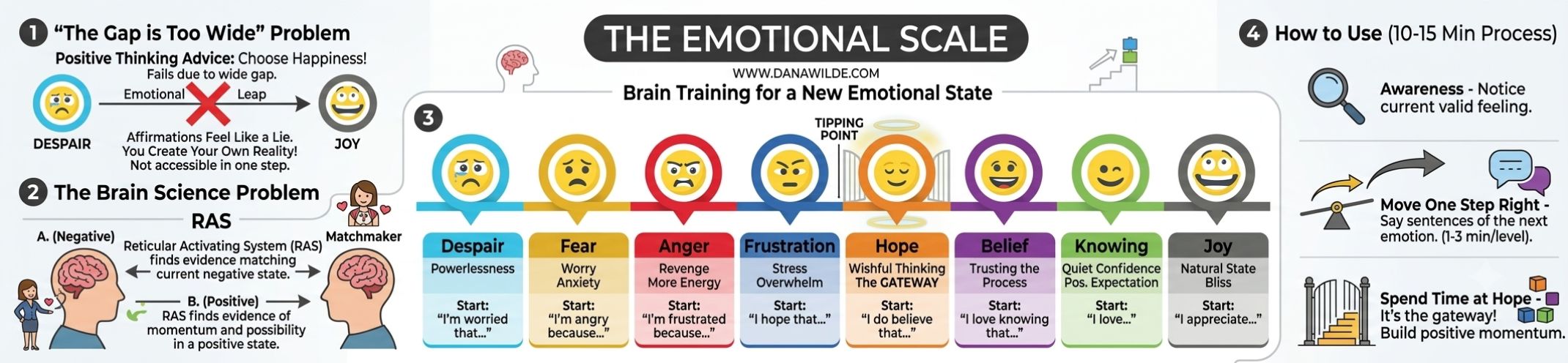
Having the scale visible when emotions are running high makes all the difference. You don’t have to remember the levels or search for this page. You just look at the chart, find where you are, and start moving one step to the right.
And if you want more free brain training tools to work with right now, here’s what’s available:
DAILY MANTRA NEWSLETTER
The Daily Mantra newsletter delivers a short, feel-good brain training directive to your inbox every single morning, before the day begins and before anything negative gets a foothold. It’s free and it’s one of the simplest daily RAS practices there is.
60 SECOND WORKSHOP
The 60-Second Workshop gives you a fast, practical brain training reset you can do in under a minute, anywhere, anytime.
MONEY BELIEFS TOOLKIT
The Limiting Money Beliefs Toolkit helps you identify and start shifting the money stories that might be quietly running your business in the background.
MARKETING SUPERPOWER QUIZ
The Marketing Superpower Quiz helps you discover the natural marketing strength you already have and are probably not fully using yet.
JOYFLUENCY CLUB
And when you’re ready to do this work inside a real community of like-minded entrepreneurs who are training their brains every week, the JoyFluency Club is where that happens. It’s where the emotional scale, the daily mantra practice, and all of the brain training tools come together in a community that genuinely understands that mindset matters most.