


Reticular activating system goal setting is the piece of the puzzle that most goal setting conversations completely leave out, and it is the piece that changes everything.
I’ ‘m guessing you have set goals before. Maybe you wrote them in a journal. Put them on sticky notes. Made a vision board. Followed the expert advice about SMART goals and quarterly planning and accountability partners.
And maybe some of it helped. But something still felt like it was missing.
I know that feeling because I have been studying this for over 40 years. And what I can tell you is this: the goals were probably not the problem. It’s more likely that your brain was just never brought on board.
When you understand how the Reticular Activating System works, goal setting stops feeling like a discipline exercise and starts feeling like a conversation with the most powerful tool you own. Your own mind.
Let me show you exactly how to have that conversation.
What Does the Reticular Activating System Have to Do With Your Goals?
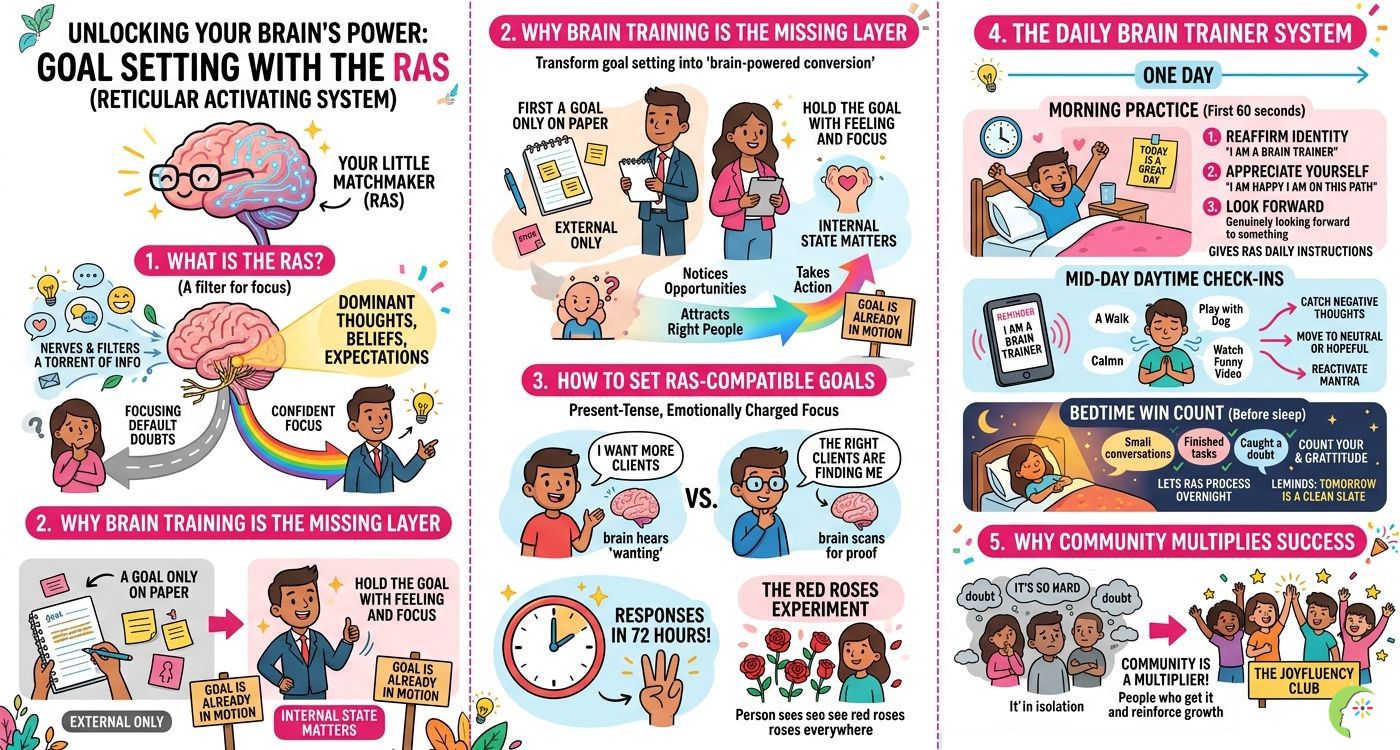
I like to call the RAS “the little matchmaker” because that is exactly what it does all day long.
The Reticular Activating System is a bundle of nerves at the base of your brainstem. Its job is to filter the millions of pieces of information your senses take in every second and decide what is worth your attention. And here’s what it uses to make that decision: your dominant thoughts, beliefs, and expectations.
Whatever you focus on consistently, your RAS goes hunting for evidence of it in your world.
Now think about what that means for your goals.
If your goal lives on a piece of paper in a notebook you open once a month, your RAS has no real directive to work from. But when your goal lives in your mind, held with consistent focus and genuine feeling, your matchmaker goes to work. It starts surfacing the right conversations, the right opportunities, the right ideas, things that were always there but that you were not yet programmed to notice.
That’s not magic. It’s just your brain doing exactly what it was designed to do.
The question is, whether you’re giving it the right instructions.
Here’s Why Most Goal Setting Advice Leaves the Brain Out of the Equation
Traditional goal setting is almost entirely external. Write the goal. Make a plan. Take action. Track results. Adjust and repeat.
None of that is technically wrong… But it misses the most important layer.
Two entrepreneurs can set the exact same goal and get completely different results. Same goal, same market, same starting point. One grows. One stays stuck.
The difference is almost never strategy, but their internal state.
The entrepreneur whose RAS is pointed toward a goal, who expects it to happen, who holds the feeling of it already being in motion, notices different things, attracts different conversations, and takes different action than the one whose RAS is quietly running on doubt and default thinking.
Brain training is the missing layer. And once you add it to your goal-setting practice, the whole thing starts to feel different.
If you want to go deeper on how the RAS works before we get into the practices, I have a full post on how to activate your Reticular Activating System that walks through the science in plain English.
How to Set Goals Your RAS Can Actually Work With
Here’s one of the most practical things I can share with you about RAS-compatible goal setting.
Your little matchmaker responds to present-tense, emotionally charged focus. Not future-tense wishes.
When you say, “I want more clients,” your brain hears: wanting. It matches that feeling and finds more evidence that you are in a state of wanting, which means not yet having. The RAS is literal like that. In other words, your brain hears, “I want more clients. I don’t have more clients. I want them. They are not here.” That is the message it’s matching. 🤦🏽♀️
When you say “the right clients are finding me now,” your brain gets an active directive. It starts scanning your environment for evidence that this is already true. And it finds it, because it always finds what you tell it to look for.
This is the shift. From “I hope this happens someday” to “this is already in motion and I can feel it.”
You don’t have to believe it 100%. You just have to say it with enough positive emotion that your RAS takes the memo seriously. Or as I like to say, “just don’t argue with it.”
And here’s the beautiful part: your RAS responds to consistent new focus within 72 hours. Three days! That’s the window. You hold a new goal-focused thought consistently for 72 hours, and your brain starts shifting what it notices, what it flags, and what it brings to your attention.
Think about the red roses experiment from my RAS exercises post. In that experiment, you said “it seems I am seeing red roses everywhere,” and within 72 hours, red roses started showing up. Not because you went hunting. Because you gave your matchmaker a directive, and it went to work.
Your business goals work the same way. Give your RAS a present-tense, feel-good directive and let it do its job.
The Morning Practice That Puts Your RAS to Work on Your Goals Every Day
I have been doing this for over 40 years, and I still come back to the same truth every single morning: the first 60 seconds after you wake up are some of the most valuable seconds of your entire day.
Here’s why.
When you wake up, that’s a complete reset. The emotional weight of yesterday is gone. The slate is clean. And whatever you choose to focus on in those first moments is the directive your little matchmaker carries into the rest of your day.
Most people pick up their phone. Check their email. Let the noise of the day rush in before they have had a single intentional thought.
Brain Trainers do something different.
I recommend putting a post-it note on your alarm clock or on the wall across from your bed. Something simple that anchors you before your feet even hit the floor. “Today is going to be a great day.” “I am a Brain Trainer.” “Good morning.” Whatever pulls you into present-moment awareness and reminds you that you want to live a positively-focused life.
When you see that note, stay in bed for about 60 seconds (if you can do it without falling back asleep). Use those seconds for three things.
- First, reaffirm your identity as a Brain Trainer. Something like: “That’s right. It is my strong desire to be aware today. I am getting better at this. I have so much going right.”
- Second, appreciate yourself. “I am happy I am on this path. I am getting better at this every day.”
- And third, look forward. Think of one thing you are genuinely looking forward to that day, even something small, and say it to yourself. If nothing specific comes to mind, say: “I am looking forward to today.”
That is it. Sixty seconds. And what you have done is hand your little matchmaker its instructions for the day before the inbox opens, before the to-do list starts, before anything else gets a vote.
Your RAS spends the rest of the day looking for evidence that today is good, that you are capable, that things are moving. And it finds it. Because it always finds what you tell it to look for.
What to Do When Your RAS Starts Working Against Your Goals Mid-Day
I want to be honest with you about something.
Brain Trainers are not peel-me-off-the-ceiling blissed out in every moment of every day. We all deal with life. Negative thoughts show up. The emotional train slows down. And that is completely okay.
The difference is awareness. When you catch yourself slipping into a negative loop mid-day, you have options.
For daytime check-ins, I love phone reminders written in present-tense celebratory language. Not “remember to think positive,” but “I am already doing it” or “I am a Brain Trainer.” When that reminder fires, take one deep breath, exhale fully, land in the present moment, and affirm that you are aware. That is the whole practice.
And here’s something important: when you are in a negative rut, do not force a mantra that feels too cheerful. When you are feeling low, “too happy” content can actually feel annoying, and that is fine! In those moments, the goal isn’t to leap from negative all the way to ecstatic. The goal is to move from negative towards neutral.
A walk. Some music. A nap. Playing with the dog. Watching something funny. Hugging yourself and saying, “It’s okay.” These are real Brain Trainer tools, not consolation prizes. Use whatever works for you in that moment.
Once you are back to neutral or hopeful, that is when the mantra and the direct RAS work kick back in. Meet yourself where you are, and gently redirect from there.
The Bedtime Practice That Lets Your RAS Process Your Goals Overnight
Here’s a secret that most goal-setting advice will never tell you.
The minutes before you fall asleep are some of the most powerful minutes of your day for RAS programming.
Your brain is in a highly receptive state as it moves toward sleep. Whatever you focus on in those last few minutes before drifting off, that is what your little matchmaker takes with it into the night. It processes those thoughts while you rest. It wires them in.
In other words, the final thirty minutes of your day before you go to sleep go directly into your unconscious mind. This time frame gives you an opportunity for nearly effortless brain rewiring.
Most people spend those minutes scrolling. Replaying the frustrations of the day. Running through the to-do list for tomorrow. Worrying about things they cannot control at 11 pm. Or even worse, watching the news!
Brain Trainers use those minutes differently.
As you fall asleep, count your wins from the day. Not just the big things. The small things, too. The conversation that went well. The piece of content you finally finished. The moment you caught a negative thought and chose a better one. Those all count.
Appreciate specific things about your life and your business. Let yourself feel gratitude for what is already here, even as you hold the goals for what is coming.
And remind yourself: sleep is a full reset. Whatever happened today, tomorrow is a clean slate. You are doing your best. You are getting better at this. Your RAS is working even while you rest.
This is your second daily opportunity to hand your little matchmaker its instructions. The morning sets the directive for the day. The bedtime practice sets the directive for tomorrow.
Two short practices. One at each end of your day. That is a complete RAS goal-setting system.
Why RAS Goal Setting Works Better When You’re Not Doing It Alone
I need to tell you something that most RAS resources will never mention.
Your little matchmaker does not only respond to your internal thoughts. It also responds to your environment.
The people you spend time with. The conversations you have. The community you’re a part of. Your RAS picks it all up and uses it as evidence about what is normal, what is possible, and what is expected.
When you are surrounded by people who are also training their brains, who hold positive expectations, who talk about their wins and cheer yours, and really believe that growth is possible, and that success doesn’t have to be hard, your RAS reads that environment as confirmation that all of that is true.
It reinforces everything you are building internally. The morning practice feels deeper. The mantra feels more true. The goals feel possible and closer.
Now think about what happens when you do this work in isolation.
The people around you may be running on pure default thinking. Talking about how hard business is. Commiserating about slow months. Expressing doubt about whether things can really change. And your RAS picks that up, too, whether you want it to or not.
Now, that’s not a reason to cut people out of your life! It’s just a reason to make sure that somewhere in your world, there is a community that is doing this work alongside you. People who get it. People who remind you, on the hard days, that you are not broken or behind.
I created the Joyfluency Club for exactly this reason. It’s where entrepreneurs train their brains together every single week, so nobody has to figure it out alone.
Community is not a nice-to-have in this work. It’s a multiplier. And your RAS will feel the difference.

For more on how mindset and business growth connect, the post on what makes entrepreneurs successful is a great companion read.
Now, read the following words out loud or to yourself, and feel the shift:
My RAS is working on my behalf right now.
My little matchmaker is on the job.
I give it clear, feel-good instructions.
Every morning, I set the directive.
Every evening, I count my wins.
I am not doing this alone.
I am surrounded by people who get it.
My goals are already in motion.
My brain is finding the evidence.
I am aware.
I am a Brain Trainer.
I am already doing this.
Right …
… NOW! WOOHOO! 🥳🎉
Your RAS is already working. It’s already filtering and looking for evidence of whatever you’re focused on most right now.
It’s up to you to give it the right instructions.
The morning practice, the daytime check-ins, and the bedtime wins count are all you need to start. Sixty seconds at each end of your day. That’s the whole system.
And if you want a ready-made RAS directive delivered straight to your inbox every single morning before the day begins, sign up for the free Daily Mantra newsletter. It’s the simplest way I know to make sure your little matchmaker starts each day pointed in exactly the right direction.
Frequently Asked Questions
How does the reticular activating system help with goal setting?
Your RAS acts as your brain’s filter, deciding what information from your environment is worth your attention. It uses your dominant thoughts and expectations as its filtering criteria. When you hold a goal with consistent, emotionally charged focus, your RAS starts scanning your environment for evidence, opportunities, and pathways toward that goal, things that were always there but that you were not yet programmed to notice. RAS-based goal setting is not about wishful thinking. It’s about giving your brain a clear directive and letting it go to work.
How long does it take for RAS goal setting to work?
Your RAS responds to consistent new focus within 72 hours. Three days of holding a present-tense, emotionally charged goal thought can produce a noticeable shift in what you notice and attract. That doesn’t mean the goal fully manifests in three days! It means your brain starts pointing itself in a new direction, and you will start to feel and see the evidence that your new mindset focus is working. The morning and bedtime practices I describe in this article are designed to give your RAS that consistent focus every single day.
What should I do if I set a goal but keep slipping into negative thinking about it?
Negative thoughts are completely normal, and they show up for everyone (including me, even after decades of brain training). The practice is not to eliminate the negative thought. It’s to catch it more quickly, name it as default thinking, and gently redirect. On hard days, don’t force a mantra that feels too far from where you are. Instead, aim for neutral first. A walk, some music (check out my Songfirmations, they are positive affirmation songs for adults, meant to gently shift your mindset), or something that makes you laugh. Once you’re back to neutral or hopeful, bring the mantra back in! Meet yourself where you are and redirect from there. That’s the Brain Trainer way.